






What research says about light and performance
Several independent studies on workplace lighting reach consistent conclusions. Key findings:
- Zumtobel Research (dynamic office lighting): 4.5 % average daily productivity gain under biodynamic vs. static lighting.
- ATKearney / EuP study (added value of modern lighting): 6–10 % higher attention, significantly lower error rate in fine-mechanical work.
- Karolinska Institutet (Swedish hospital study): 30 % fewer visual complaints at UGR ≤ 19 vs. ≤ 25.
These numbers are averages over large samples. In a specific plant they vary — but the direction is stable and reproducible.
Concrete effects on error rates and quality
Lighting has its biggest leverage in fine-mechanical visual work (sorting, QC, assembly). Experience values from industrial projects:
- Raising illuminance from 300 to 750 lx at inspection stations → 15–25 % fewer complaints
- Raising colour rendering from Ra 80 to Ra 90 for colour control → significantly fewer mis-sorts
- Switching to UGR ≤ 19 (low glare) → less eye fatigue from mid-shift, fewer follow-on errors in the second half of the shift
In a processing plant with €100,000 annual rework cost, a 20 % reduction is a direct €20,000/year saving — against a one-off lighting investment of maybe €30,000. ROI < 18 months.
Energy ROI: TCO calculation against legacy installations
The classic argument for an LED upgrade — and usually the only one that gets traction in controlling. Sample calculation for a hall with 50 T8 luminaires (each 58 W + ballast = 70 W system load):
- Legacy: 50 × 70 W × 4,000 h/year = 14,000 kWh/year ≈ €4,200 at €0.30/kWh
- LED replacement at 35 W with equal light output: 50 × 35 W × 4,000 h = 7,000 kWh/year ≈ €2,100
- Energy saving: €2,100/year
- Plus maintenance saving: T8 tubes last ~12,000 h, LEDs 50,000 h → 4× fewer replacement events
- Investment for the LED retrofit: about €8,000–€12,000
- ROI: 3.5 to 5.5 years on pure energy + maintenance terms
Add productivity and error-reduction effects and the ROI typically halves.
Human Centric Lighting — beyond lumens
Modern lighting strategy is not "as bright as possible" but "fit for visual purpose". Keyword Human Centric Lighting (HCL):
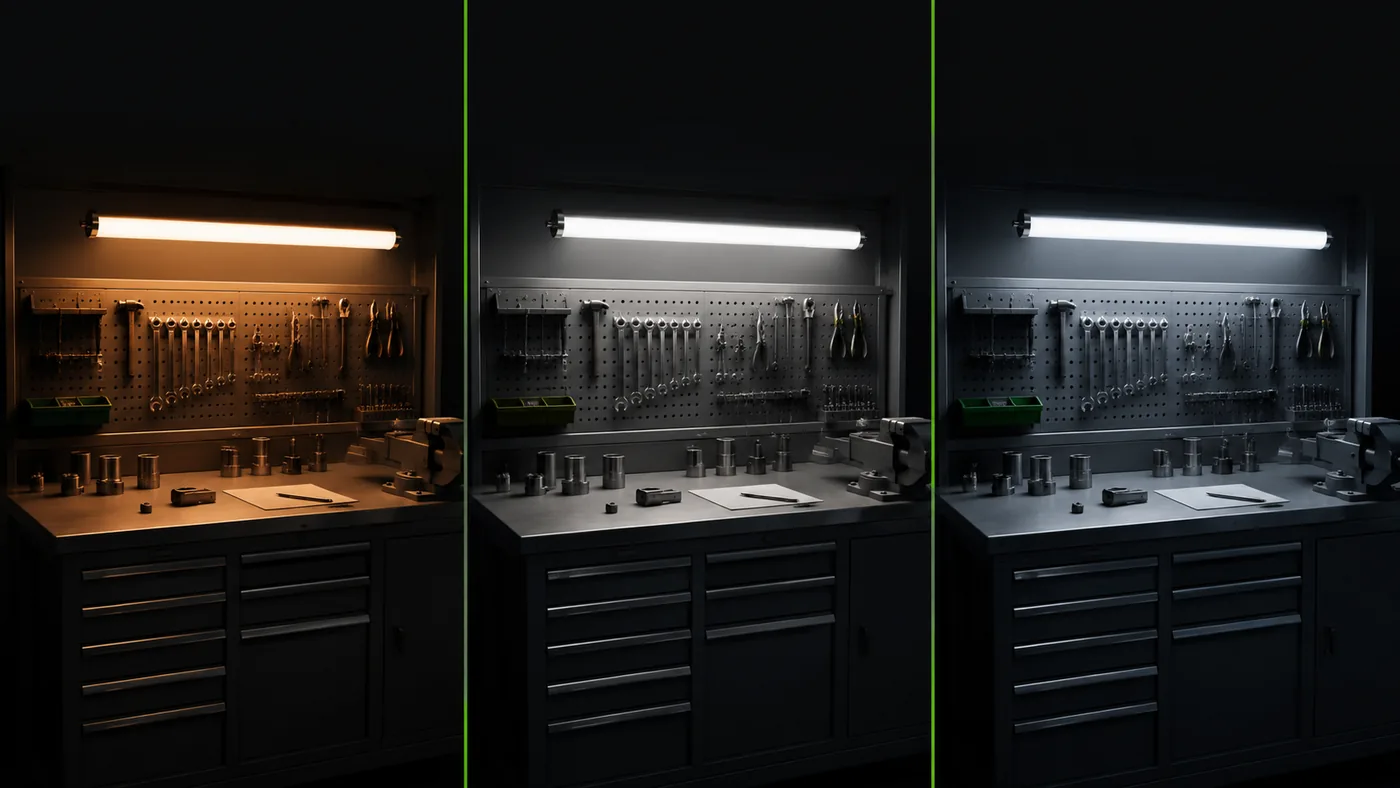
- Dynamic colour temperature across the day — cool in the morning (activation), warmer in the afternoon (concentration), warm in the evening (shift-change preparation)
- Vertical illuminance matters — not just task lighting, the surrounding ambient lighting drives circadian rhythm and attention
- Individual control where possible — studies show 5–10 % higher satisfaction when employees can adjust their lighting locally
HCL is not a marketing buzzword but an empirically validated strategy — and already standard in modern office buildings. In industry it is increasingly used for shift work and inspection stations.