






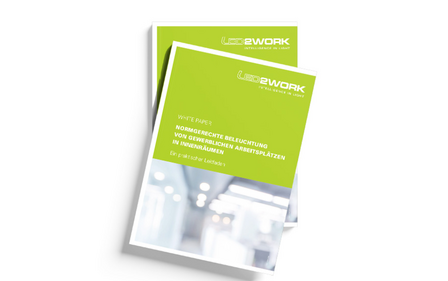
ArbStättV and ASR A3.4 — the legal framework
In Germany, the Workplace Ordinance (ArbStättV) sets out the basic requirements for workplaces. Lighting is detailed by the technical rule ASR A3.4 "Lighting", which itself refers to DIN EN 12464-1:2021.
For employers this means: complying with ASR A3.4 is not optional. It carries a statutory presumption of compliance — applying it satisfies the Workplace Ordinance, deviating from it requires proof that the alternative solution is equivalent.
Minimum illuminance by activity
ASR A3.4 and DIN EN 12464-1:2021 specify the following maintained illuminance levels (measured at the visual task, not initial values) for typical workplace activities:
- Warehousing / traffic routes: 100 lx
- Rough assembly, packing: 200 lx
- Medium assembly, machine operation: 300 lx
- Fine assembly, quality inspection: 500 lx
- Very fine work, micro-assembly, screen work combined: 750–1,500 lx
- First-aid rooms, surgical preparation: 1,000 lx and above
Uniformity U₀ ≥ 0.6 (0.7 for screen work) and glare limitation UGR ≤ 19 for screens / UGR ≤ 22 for general industry are additional mandatory parameters.
Daylight is mandatory, not optional
ASR A3.4 requires sufficient daylight in continuously occupied workrooms. In concrete terms: daylight factor ≥ 2 % at at least half of all workstations, visual connection to the outside for occupants.
Where this is structurally impossible (windowless halls, cleanrooms, basements), artificial lighting must compensate via colour temperature and dynamics — typically daylight-white (5,000–6,500 K) with intensity varying through the day ("biodynamic lighting").
Consequences of non-compliance
Violations of the Workplace Ordinance are pursued by the occupational safety inspectorate. Possible outcomes:
- Notices with deadline — remediation within 4–12 weeks, otherwise follow-up measures
- Fines up to €30,000 for wilful or grossly negligent violations (§ 25 ArbStättV)
- Personal liability of senior management in case of repeated violations
- Insurance relevance: after a workplace accident, the statutory accident insurer checks whether minimum lighting was provided — employer co-responsibility can reduce benefits
Pragmatic approach: measure illuminance with a calibrated lux meter directly at the visual task, document once per year, recheck on rebuilds or new installations.