






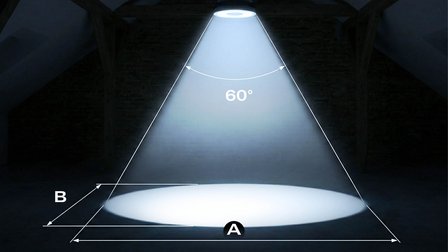
Beam Angle
The beam angle indicates the angle at which most of the light is projected forward. This angle depends on the type of fixture (spot fixture or area fixture) and ranges between 10° and 125°. For focused lighting (spot fixtures), we offer LED luminaires with 10°, 16°, 25°, or 40° optics, where a lens concentrates the light and prevents scattering. For area fixtures, the goal is to illuminate a larger surface uniformly; these fixtures feature angles of 60°, 100°, 120°, and 125°.
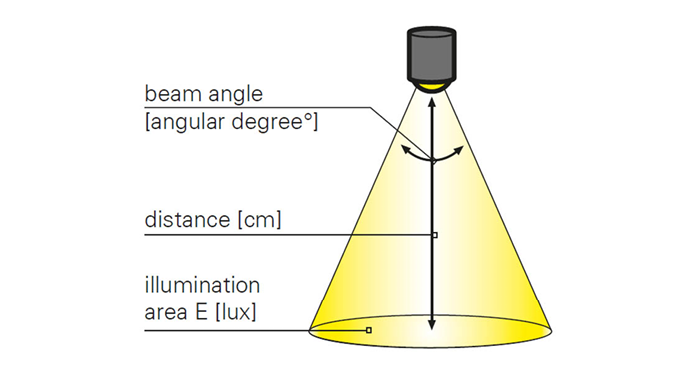
Light-Forming Technology (LED2WORK-specific term)
The LED chip itself has a beam angle of 120°. Using highly reflective aluminum reflectors and specialized light-diffusing films, the light is directed and precisely enhanced.
Light distribution curves and classes
The spatial distribution of light is described by the luminous intensity distribution curve (LIDC). Two basic forms are distinguished in industry:
- Rotationally symmetric: light is emitted uniformly around the lamp axis. Typical for high-bay and spot luminaires.
- Asymmetric / batwing: light is distributed sideways with a minimum directly below the luminaire. Reduces gloss veil and double shadows on machines and elongated workstations.
For workplace lighting, the glare control factor (K-value) indicates the lateral shielding. Lower K-values mean reduced glare at visual-task workstations. DIN EN 12464-1 specifies minimum requirements on the light distribution for different visual tasks.
Photometric data formats for lighting design
Industrial luminaires are evaluated in lighting design software (e.g. DIALux, Relux) using standardised data sets. Three formats are widespread:
- EULUMDAT (.ldt): European de-facto standard, compact and well readable.
- IES (.ies): North American standard per IESNA LM-63, supported worldwide.
- CIE i-format: less common, requested by individual planners.
For a reliable lighting design at least one data set in LDT or IES format should be available from the manufacturer for every industrial luminaire. Plain datasheet values (lumens, beam angle) do not replace a complete LIDC.